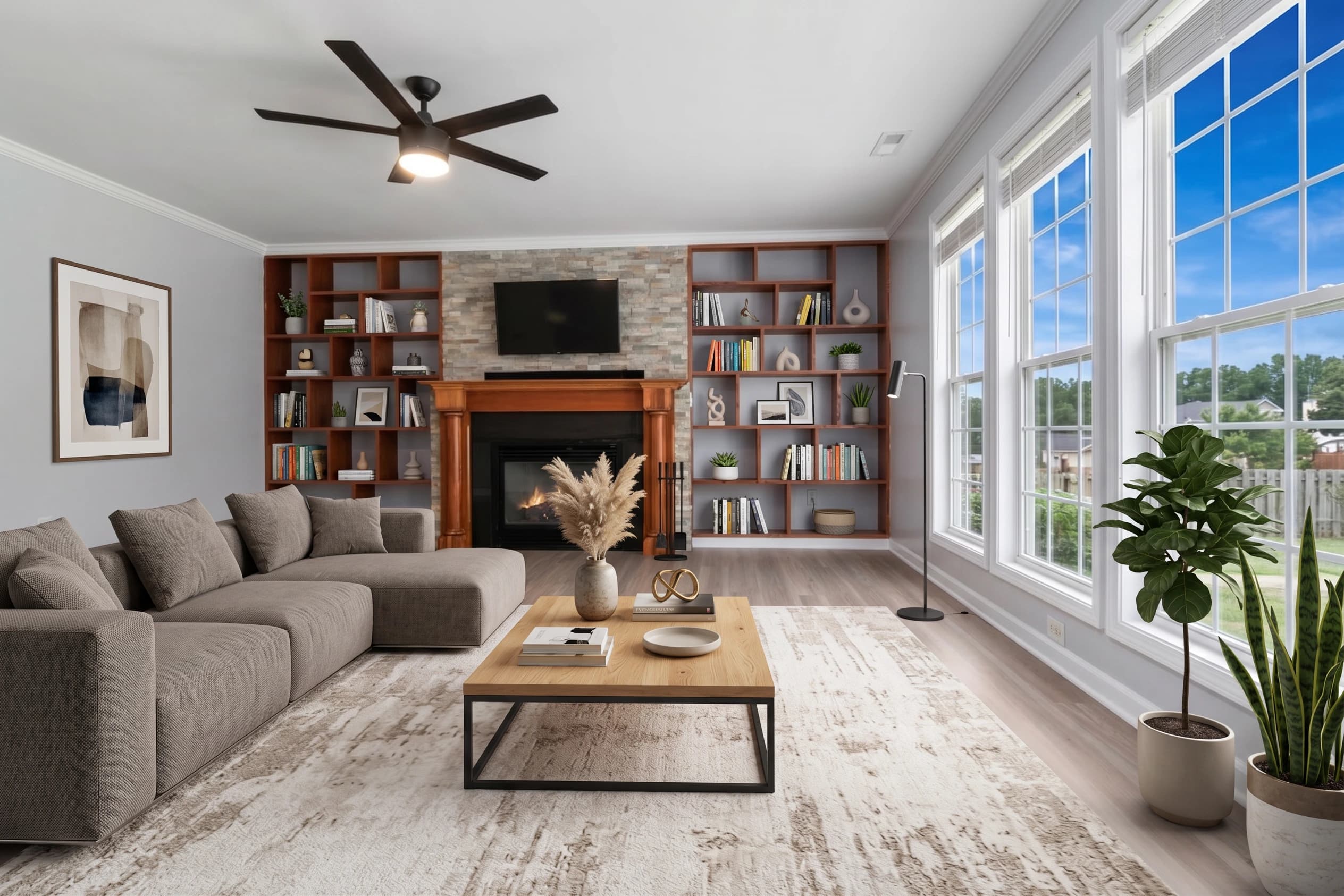
Selling a vacant home is one of the most challenging scenarios in real estate. Empty rooms are psychologically difficult for buyers — without furniture for scale reference, rooms often feel smaller than they are. Buyers struggle to envision living in the space. The result: longer market time and lower offers.
Two solutions exist: physical staging and AI virtual staging. This guide compares both head-to-head so you can make the right call for each listing.
Why Vacant Homes Are Harder to Sell
Research on vacant home sales is consistent and striking:
- Vacant homes sell for 11% less than furnished equivalents, on average (National Association of Realtors)
- Buyers spend 75% more time viewing staged listing photos online vs. unstaged
- 62% of buyers say staging makes it easier to visualize a property as their future home (The Zebra)
- Vacant listings sit on the market 79% longer than appropriately staged listings
These aren't marginal numbers. The staging decision is one of the most impactful choices in the listing marketing process.
Physical Staging: The Classic Approach
Physical staging involves a professional stager bringing actual furniture, art, plants, and accessories into the property for the duration of the listing period.
How It Works
- Stager consults on the property and develops a staging plan
- Furniture is transported and installed (typically from a stager's warehouse inventory)
- Property is photographed with staging in place
- Staging remains in place for all showings during the listing
- Furniture is removed when the listing sells or expires
Physical Staging Costs
| Property Size | Average Cost | Range | |---|---|---| | Under 1,000 sq ft | $1,200 | $800–$1,800 | | 1,000–2,000 sq ft | $2,100 | $1,400–$3,000 | | 2,000–3,500 sq ft | $3,500 | $2,200–$5,000 | | 3,500+ sq ft | $5,500+ | $4,000–$10,000+ |
Important: Most staging companies charge a monthly rental fee after the first month — typically $500–$1,500/month. If the listing takes 60+ days to sell, costs compound significantly.
Physical Staging: Pros and Cons
Pros:
- Buyers see staging in person at showings — the most powerful buying trigger
- Staged rooms photograph and show equally well
- High-end stagers create genuinely beautiful, aspirational spaces
- No disclosure requirement (it's physical furniture)
- Helps buyers emotionally connect during in-person showings
Cons:
- Very expensive, especially for larger properties
- Requires scheduling movers and stagers
- Monthly carrying costs if the property doesn't sell quickly
- Style may not match buyer preferences
- Furniture may get damaged during the listing period
- Not practical for properties in secondary markets or rural areas
- Sellers can't occupy the property normally with staged furniture
AI Virtual Staging: The Modern Alternative
AI virtual staging digitally adds furniture and decor to empty room photos, creating realistic staged listing images without any physical furniture.
How It Works
- Shoot the empty property (ideally by a professional photographer)
- Upload empty room photos to an AI virtual staging platform
- Select staging style (modern, traditional, Scandinavian, luxury, etc.)
- AI generates photorealistic staged images in seconds to minutes
- Use staged images in MLS listing, marketing materials, and online portals
- Show the property empty (with or without virtually staged printouts or tablets for context)
AI Virtual Staging Costs
| Provider | Cost Per Room | Turnaround | |---|---|---| | fotolabs AI | $8–$20 | Seconds | | Virtual Staging AI | $10–$25 | Minutes | | Manual services (BoxBrownie) | $35–$75 | 24–48 hours | | Premium manual (Styldod) | $50–$100 | 24–72 hours |
Full listing AI virtual staging (6 key rooms): $50–$120 total
No ongoing monthly fees. The staged images exist permanently and can be used in all marketing materials.
AI Virtual Staging: Pros and Cons
Pros:
- Dramatically lower cost (95% less than physical staging)
- Instant delivery — available same day as photos
- No physical logistics — no movers, no scheduling
- Multiple style options simultaneously — show the same room in modern AND traditional
- Works for any property regardless of location or access
- Permanent assets — use in future marketing materials
- Safe to use for properties occupied by tenants
Cons:
- Buyers see the empty home at showings (can be jarring after seeing staged photos)
- Requires disclosure in most markets
- Cannot replace the in-person emotional impact of physical staging
- Quality varies significantly between providers
- Not appropriate for ultra-luxury listings where physical presentation matters
The Key Decision: Physical vs. Virtual
The staging decision depends on several factors:
Use Physical Staging When:
- Listing price is $800K+ — the marketing budget justifies it and buyer expectations demand it
- The market is competitive — multiple offers require standout in-person presentation
- The property needs help in person — awkward layouts or small rooms that need furniture to "fix" the space during showings
- The listing agent is offering white-glove service and includes staging as a differentiator
Use AI Virtual Staging When:
- Budget is a primary constraint — sellers who resist spending on staging
- The property is in a secondary or remote market — stagers may not be available or willing to travel
- The listing is below $600K — cost of physical staging is a higher percentage of commission
- Turnover is needed quickly — AI staging doesn't require scheduling
- The property is tenant-occupied — can't physically stage without disrupting occupants
- You need multiple style options — show the same room in 3 different design styles to appeal to different buyers
The Hybrid Approach:
Many high-performing agents use both:
- AI virtually stage for online listing presence (where 90%+ of buyer initial discovery happens)
- Bring in a partial physical staging kit for showings — just key pieces for the living room and primary bedroom
- This captures most of the benefit of both approaches at a fraction of full physical staging cost
Impact on Online Engagement: Virtual vs. Physical Staging Photos
Here's a critical distinction: online listing views are driven by listing photos, not the actual property. Buyers decide whether to schedule a showing based on photos — before ever stepping foot inside.
This means AI virtual staging has essentially the same impact on online engagement as physical staging photography. Both result in rooms with furniture in the listing photos. The difference emerges only at in-person showings.
For listings where the seller's primary goal is maximum online visibility and faster offers, AI virtual staging delivers equivalent results to physical staging photography for 5% of the cost.
Disclosure Requirements for AI Virtual Staging
Virtual staging disclosure requirements vary by state and MLS:
- NAR guidelines: Require that all digitally altered images be clearly labeled
- Most MLSs: Require "virtually staged" notation on altered images
- Best practice: Add "Virtually Staged" text overlay on all virtually staged photos
- MLS photo captions: Include disclosure in caption text
This requirement is not a problem — most buyers understand and accept virtual staging. The disclosure simply manages expectations before the showing.
Virtual Staging Quality: What to Look For
Not all AI virtual staging platforms produce the same quality. Evaluate based on:
✅ Photorealistic furniture — no plastic-looking or obviously computer-generated items
✅ Accurate lighting — furniture shadows must match the room's actual light direction
✅ Proper scale — furniture must be proportional to room dimensions
✅ Style consistency — all pieces in a room should belong to a cohesive design style
✅ Natural placement — furniture should be positioned as a human would arrange it
✅ No visible artifacts — no floating edges, transparency issues, or unrealistic reflections
fotolabs AI virtual staging is trained on millions of professional interior design images, producing results that consistently meet these standards.
ROI Comparison: Physical vs. AI Virtual Staging
For a $500,000 listing with an expected DOM of 30 days:
Physical Staging ROI
- Cost: $3,000 (mid-range, 30 days)
- Benefit: 11% price premium potential = $55,000 (if fully realized)
- DOM benefit: -15 days faster sale = $3,000 in carrying cost savings
- Net benefit: $58,000 benefit on $3,000 investment ✅
AI Virtual Staging ROI
- Cost: $100 (6 rooms)
- Online engagement benefit: Equivalent to physical staging for listing photos
- Showing conversion benefit: Somewhat lower (empty home at showings)
- DOM benefit: -10 days faster sale (estimated) = $2,000 savings
- Net benefit: $2,000 benefit on $100 investment ✅
The absolute dollar benefit of physical staging is higher for the right property. But AI virtual staging's return on investment is dramatically higher — especially for properties below the luxury threshold.
Making the Decision
The staging question isn't physical OR virtual — it's which approach fits this property, this seller, and this market:
- Luxury listing with motivated seller: Physical staging
- Mid-market listing with budget-conscious seller: AI virtual staging + partial physical key pieces
- Turnkey new construction: AI virtual staging
- Tenant-occupied investment property: AI virtual staging
- Property in remote market: AI virtual staging
- Competitive seller's market: AI virtual staging (physical staging matters less when buyers are motivated)
- Buyer's market with 90+ day expected DOM: Physical staging (buyers have choices and show up with critical eyes)
Get Started with AI Virtual Staging
fotolabs makes professional AI virtual staging fast and affordable. Upload your empty room photos, select a design style, and receive photorealistic staged images in seconds. Transform vacant spaces into compelling buyer experiences — without the cost and logistics of physical staging.