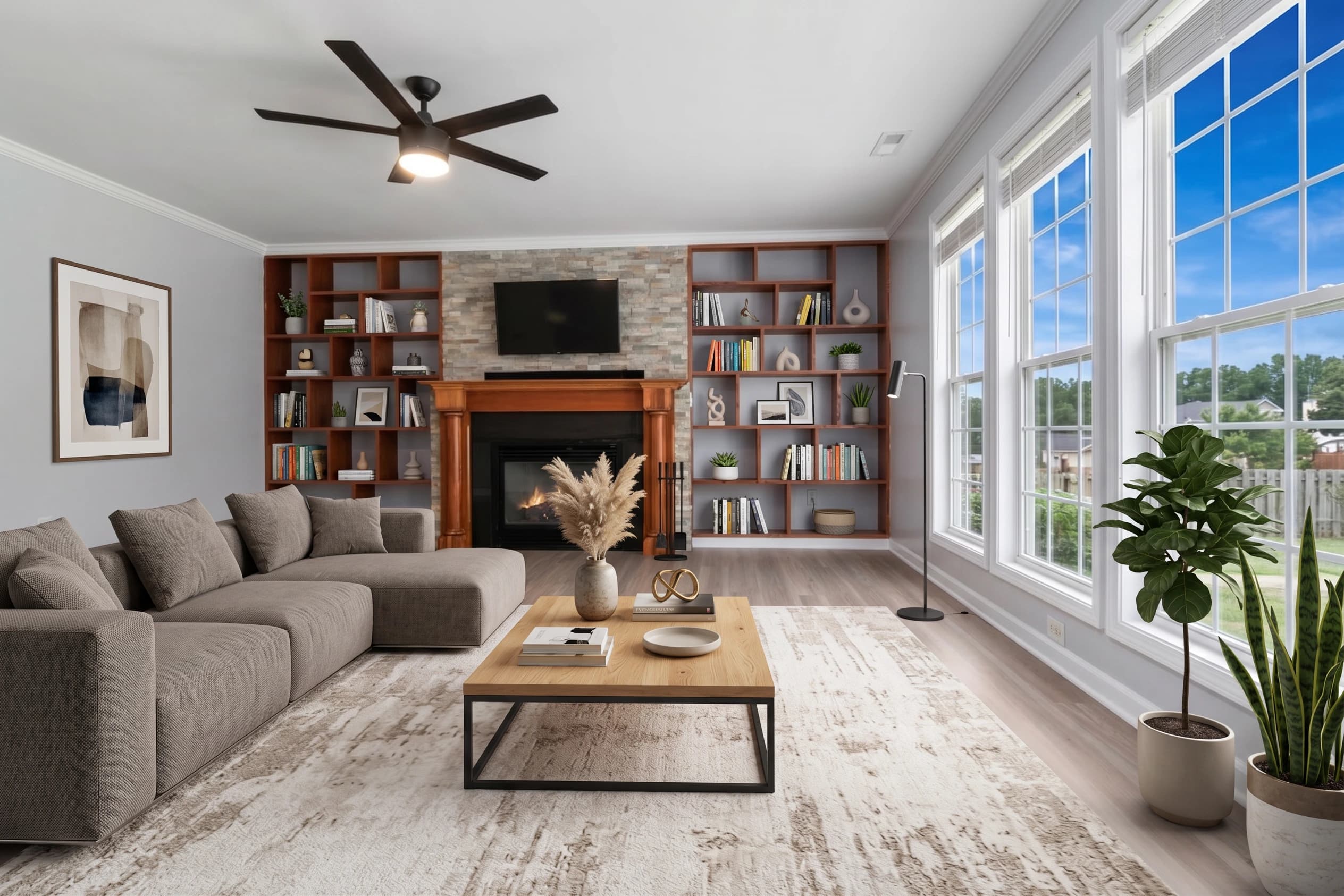
Virtual staging has completely changed how real estate agents sell empty homes. But in 2026, a new wave of AI virtual staging is replacing manual outsourcing — delivering results in minutes rather than days, at a fraction of the cost. This guide covers everything you need to know.
What Is AI Virtual Staging?
AI virtual staging is the process of digitally furnishing and decorating an empty room using artificial intelligence, rather than physically staging it or using a human designer working in Photoshop. Modern AI models are trained on millions of interior design images, allowing them to realistically place furniture, rugs, art, and decor into unfurnished spaces with accurate lighting, shadows, and perspective.
The result: a fully staged, buyer-ready room image in seconds.
Why Virtual Staging Beats Physical Staging
Traditional physical staging costs between $1,500 and $5,000 per property, requires scheduling movers, and can take a week to set up. Virtual staging — whether AI or manual outsourcing — costs dramatically less. But AI virtual staging takes it even further:
| Method | Cost | Turnaround | Revisions | |---|---|---|---| | Physical staging | $1,500–$5,000 | 3–7 days | Expensive | | Manual virtual staging | $50–$150/room | 24–72 hours | Limited | | AI virtual staging | $5–$25/room | Seconds | Instant |
For agents handling dozens of listings per year, this difference is enormous. A team processing 50 listings annually could save $30,000 or more switching from physical to AI virtual staging.
What Rooms Does AI Virtual Staging Work Best For?
AI virtual staging works for virtually any interior space, but performs especially well for:
- Living rooms — the most important room for buyer first impressions
- Master bedrooms — helps buyers visualize scale and livability
- Dining rooms — often awkward empty, instantly appealing when staged
- Home offices — increasingly important for today's remote-work buyers
- Outdoor patios and decks — can add virtual furniture and greenery
Kitchens and bathrooms typically don't need staging since they already have fixtures, but AI can enhance them with styling touches.
Key Features to Look for in AI Virtual Staging Software
Not all AI virtual staging tools are equal. Look for:
1. Photorealistic Output
The staging should blend seamlessly with the original photo. Furniture shadows must match the room's lighting direction, and textures should look real — not like clip art pasted on top.
2. Style Variety
Buyers come in all preferences. The best AI virtual staging platforms offer multiple design styles: modern minimalist, mid-century, Scandinavian, coastal, transitional, and luxury.
3. Automatic Room Detection
Top AI tools auto-detect the room type and suggest appropriate furniture layouts. You shouldn't need to manually specify "bedroom" every time.
4. High-Resolution Output
Listings require high-resolution images — at minimum 2000px wide, ideally 3000px+. Low-resolution staged images look cheap and undermine listing quality.
5. Fast Turnaround
The whole point of AI is speed. Any tool taking more than a few minutes per image is underperforming.
How AI Virtual Staging Works: The Technology Behind It
Modern AI virtual staging uses a combination of diffusion models and depth estimation networks. Here's a simplified breakdown:
- Room analysis — The AI analyzes the room's geometry, identifies floor, walls, windows, and existing elements
- Lighting estimation — It maps the light sources and their directions for accurate shadow generation
- Furniture placement — Using the room's proportions, it selects and places appropriately scaled furniture
- Inpainting — The AI blends the new furniture into the scene, matching textures and lighting exactly
This is fundamentally different from older "template overlay" methods, which simply placed PNG cutouts of furniture on top of photos. Modern AI-generated staging is photorealistic and indistinguishable from a professionally staged and photographed room.
Legal and Disclosure Requirements
Most states require that virtually staged photos be labeled as virtually staged in the listing. The NAR and most MLSs have clear policies: you must disclose that images have been digitally altered.
Best practices:
- Add a small "Virtually Staged" watermark or caption to all staged images
- Ensure buyers know the home is actually empty when they visit
- Never use staged images to misrepresent fixed features (e.g., don't paint walls a different color virtually without disclosing it)
AI Virtual Staging vs. Manual Virtual Staging Services
Companies like BoxBrownie, Stuccco, and Apply Design offer manual virtual staging where human designers work in Photoshop or 3D rendering software. These services produce high-quality results but cost more and take longer.
AI virtual staging advantages:
- 10–100x faster (seconds vs. hours)
- 3–10x cheaper per image
- No minimum order quantities
- Instant revisions
- Available 24/7
When manual staging might still win:
- Ultra-luxury listings where pixel-perfect perfection is required
- Complex architectural spaces requiring custom 3D modeling
- Clients with very specific furniture brand requirements
For the vast majority of residential listings, AI virtual staging is now the clear choice.
Best Practices for AI Virtual Staging Photos
To get the best results from any AI virtual staging tool:
- Shoot empty rooms — remove all furniture and clutter first
- Use a wide-angle lens — captures the full room for better AI analysis
- Shoot at eye level — avoid extreme high or low angles
- Keep windows in frame — natural light helps the AI understand lighting direction
- Shoot in RAW or high-quality JPEG — more image data means better AI output
- Avoid motion blur — use a tripod if needed
How AI Virtual Staging Is Changing Real Estate Marketing
The democratization of virtual staging is having a measurable impact on the market. Agents who previously couldn't justify staging costs for mid-range properties now stage everything. This raises the baseline quality of listings across the board — which means buyers increasingly expect staged photos.
Listings with professional-quality staged photos:
- Receive 40% more online views on average
- Sell 73% faster than unstaged equivalents (per NAR research)
- Often receive higher offers — buyers can envision living in the space
Getting Started with AI Virtual Staging at fotolabs
fotolabs offers AI virtual staging software as part of its real estate photo enhancement suite. Upload your empty room photos, select a staging style, and receive photorealistic staged images in seconds. No subscriptions required — pay only for what you process.
Ready to stage your next listing? Start transforming empty rooms into buyer magnets today.