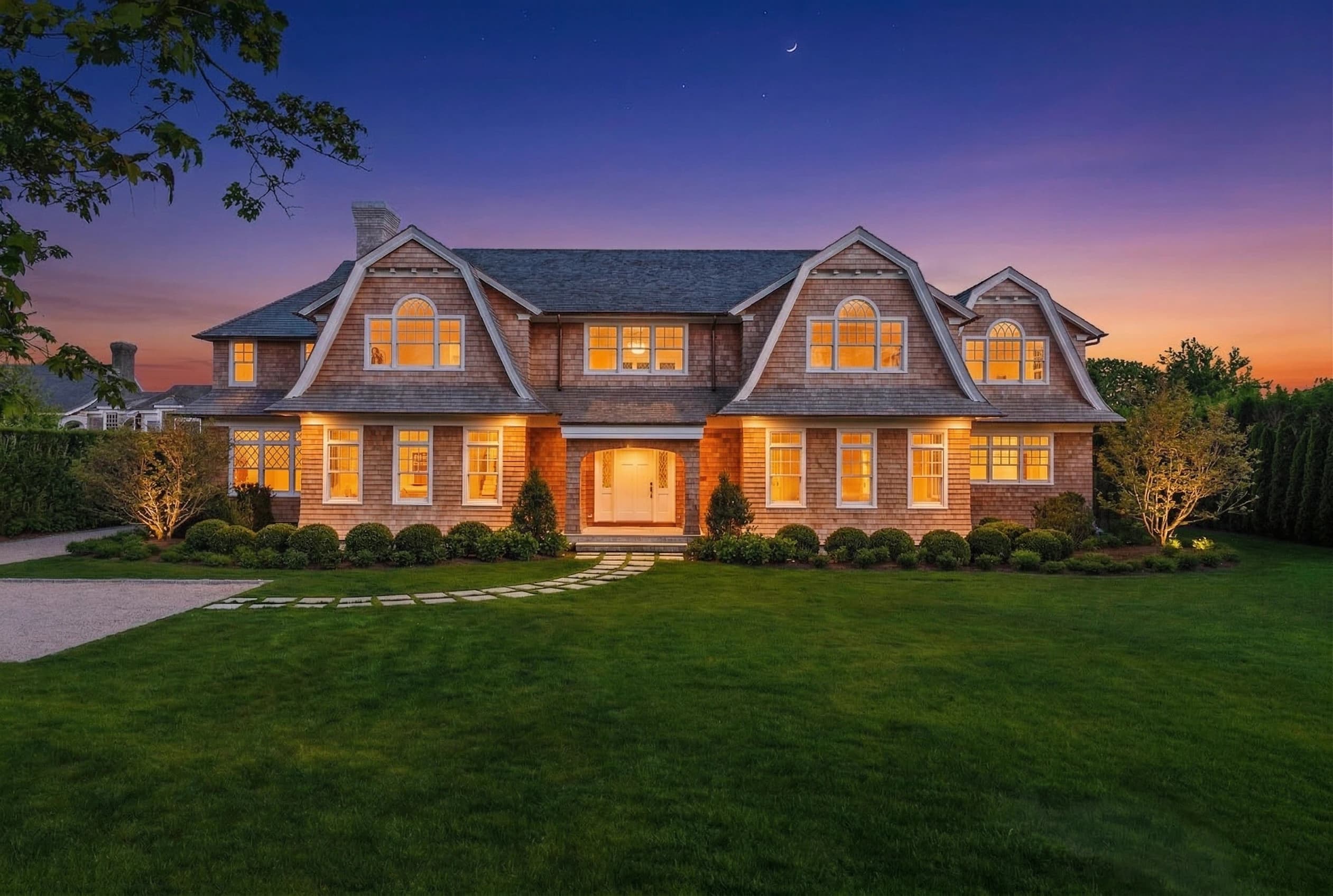
The Twilight style is the single most over-performing photo edit in real estate marketing. Listings that lead with a twilight exterior shot get 35–50% higher click-through rates on photo #1 versus the same listing leading with a daylight exterior — across nearly every market, every price point, every property style. That's the lift the Twilight style is designed to capture, in 30 seconds, without scheduling a second site visit at the actual blue hour.
This page covers what the style does, when to use it, and how it stays MLS-compliant.
What this style does
When you apply the Twilight style to a daylight exterior, the model does five things in sequence while keeping the home itself untouched:
- Resolves the sky into a deep dusk gradient — typically navy at the top fading through purple to a warm orange band along the horizon. The exact color blend matches the time of evening that fits the property's geography and architecture.
- Illuminates the windows from the inside with warm tungsten glow. Every visible window gets light at appropriate intensity (kitchen brighter, bedrooms softer, basement dim).
- Lights the exterior fixtures — porch lights, landscape lighting, garage carriage lights, walkway path lights — at realistic intensity.
- Shifts ambient color temperature to evening — the lawn cools to a deep green, the driveway picks up warm edge light from the front-door fixture, the siding takes on the soft purple tones that real twilight photography captures.
- Preserves architecture and landscaping exactly. No new shutters. No moved trees. No removed power lines (use Object Removal for that). The home in the photo is the home in real life — just at a different time of day.
The result reads as a deliberately styled marketing shot, not a fake. That's why MLS boards accept Twilight-edited photos.
When to use the Twilight style
Twilight isn't the right call on every listing, but it's the right call more often than people use it. Reach for Twilight when:
- The home has good exterior architecture. Twilight emphasizes silhouette and form. Cape Cods, modern builds, custom homes, and homes with strong rooflines benefit most. Cookie-cutter spec houses still benefit but the lift is smaller.
- The home has visible exterior lighting (porch lights, sconces, landscape uplighting). Twilight makes them earn their keep — and signals to buyers that the home looks great at night.
- The neighborhood is a daytime weakness. A street with overhead power lines, a tired neighbor's house, or a strip-mall view across the road photographs better at twilight because those weaknesses recede into shadow.
- The market expects it. Luxury listings ($1M+ in most metros, $2M+ in HCOL areas) are increasingly twilight-by-default on the lead exterior. Skip twilight and the listing reads "downmarket."
When not to reach for twilight: small condos, mid-day-only sales photos with no exterior, and listings where the agent has a strong brand preference for natural-light editorial photography.
Twilight for interiors
Most agents apply twilight to exteriors only, but interior twilight is the under-used cousin. Living rooms and primary bedrooms with view-facing windows — water, city, mountain, golf course — gain enormous selling power when the visible sky outside is dusk and the room's lamps glow warm. It's the look that converts "house with a view" into "lifestyle worth paying for."
The model handles interior twilight by lighting visible fixtures (table lamps, floor lamps, pendants, fireplace if present), shifting the visible sky outside windows to dusk, and color-balancing the interior to match the evening light spilling in.
MLS compliance and disclosure
Twilight editing is widely accepted on MLS because it doesn't modify the home itself — only the lighting and sky, which vary naturally throughout the day. That said, some boards require a "Twilight Edit," "Sunset," or "Dusk Photo" caption on twilight-edited images. Standard practice:
- Add a caption: "Twilight edit" or "Sunset view (edited)" on each affected photo.
- Optionally include both daylight and twilight versions in the photo set — many top agents lead with twilight (photo #1) and follow with the daylight version (photo #2 or #3).
- Check your local MLS rules — Bright MLS, Stellar MLS, and California Regional MLS each have their own preferred language.
What's never compliant under any rule: adding lights to a home that doesn't have them, changing the architectural style, or showing a sky/landscape that materially misrepresents the property (e.g., a mountain view that isn't actually visible). The Twilight style doesn't do any of those — it only animates the light fixtures and lights that already exist.
Cost and turnaround
Outsourced twilight editing services charge $20–$50 per image with 24–48 hour turnaround. fotolabs Twilight is included in every paid listing plan with no per-image upcharge:
- Free: 30 watermarked images per listing.
- Essential ($25/listing PAYG, $14/listing on monthly): 50 images, no watermark.
- Ultimate ($30/listing PAYG, $25/listing on monthly): 100 images, priority processing.
A typical listing uses Twilight on 1–3 exterior shots, occasionally 1–2 interiors with views. At Essential pricing that's effectively $0.50–$2.50 per twilight edit, vs $20–$50 outsourced.
Try the Twilight style free
Upload your most recent exterior daylight shot and apply the Twilight style on the free plan. You'll see whether the lift in mood and click-through justifies adding twilight to your default workflow. Free plan output is watermarked but uses the same model — quality is identical to paid output minus the watermark.
If the result works on your listings, upgrade to Essential or Ultimate. No subscription required for per-listing usage. Credits roll over, photos stay on our infrastructure for life.